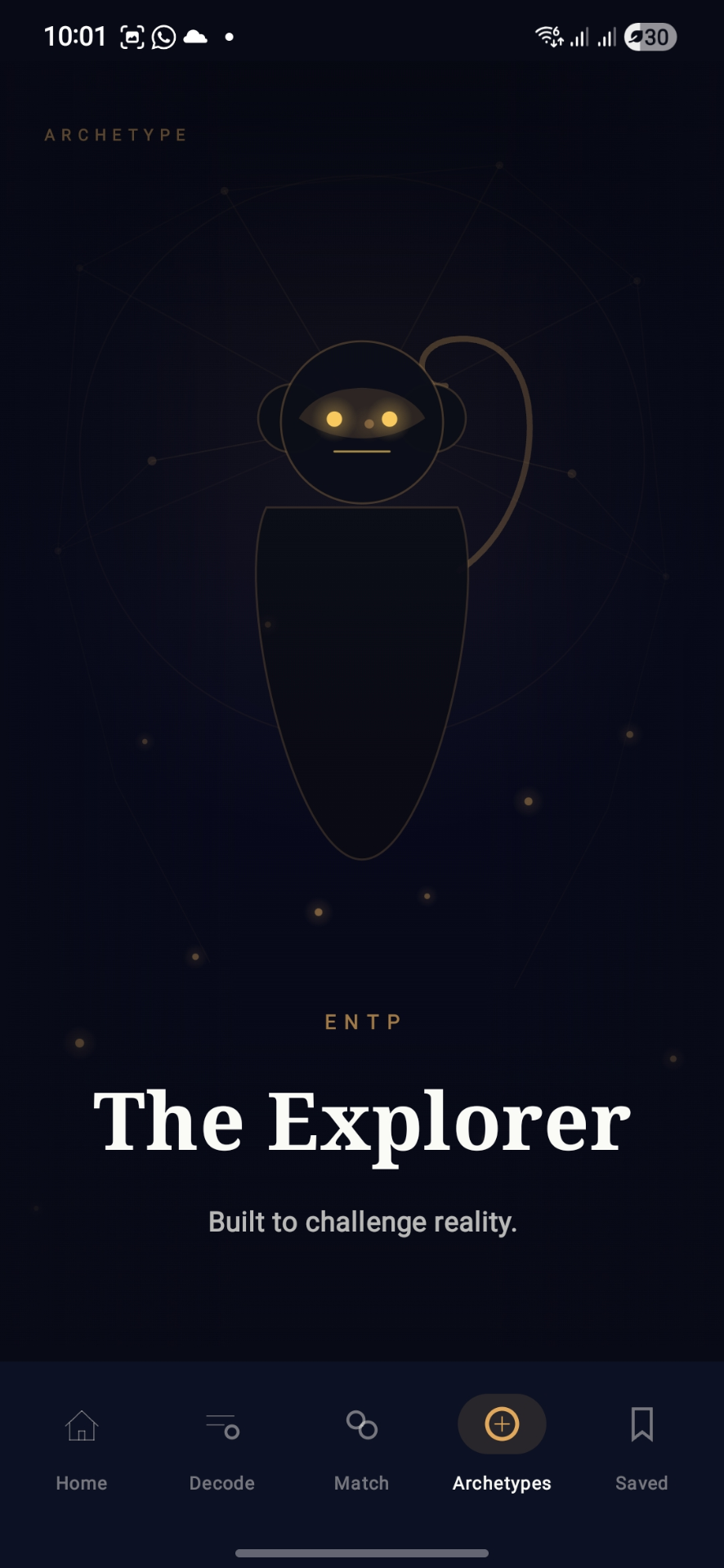
The Explorer
The Explorer
The Explorer doesn't break the rules. They just never agreed to them in the first place.
They believe that everything is provisional — every system, every belief, every settled conclusion is a hypothesis waiting to be stress-tested. The world is more interesting as an open question than as a fixed answer. They hold almost nothing as permanent, which is both their greatest asset and the thing that makes sustained commitment genuinely difficult to navigate.
Fast. Branching. Constantly generating new connections between things that appear unrelated. The Explorer's internal experience feels less like deliberate thinking and more like watching a map draw itself in real time. They do not arrive at conclusions — they accumulate them from multiple simultaneous directions and synthesise somewhere the analysis was not expecting to land. Being inside their mind feels like exploration rather than deliberation. The problem is that exploration has no natural endpoint.
To be intellectually matched by someone who also stays. They can find intellectual peers. They can find people who stay. Finding both in the same person is the search they do not always admit they are conducting. Beneath the irreverence and the debate and the need for freedom is someone who wants to be in a room with another mind and not feel alone in it.
Debate is their native language and they use it as a form of intimacy, which does not always land that way for the other person. They challenge ideas — including ideas people are emotionally attached to — because challenge is how they engage, not how they attack. They move fast in conversation and are often several steps ahead of where the other person is, which creates a specific kind of loneliness even when surrounded by people genuinely trying to keep up.
The pattern connector. It sees what things could become, maps how ideas relate to other ideas across fields and categories, and never stops generating possibilities. It does not rest. It is the Explorer's engine and their restlessness.
The internal logic engine. It stress-tests every idea Ne generates for structural integrity. The Explorer is not just producing possibilities — they are simultaneously breaking them. Only the ones that survive both functions make the cut.
The emotional awareness that arrives later than it should. The Explorer genuinely cares about people. The caring tends to arrive after the debate rather than before it, which creates a timing problem that costs them regularly.
Memory, the body, and the past. Under significant stress, Si takes over unexpectedly — the Explorer retreats into nostalgia, becomes uncharacteristically risk-averse, or fixates on past experiences in a way that looks nothing like their usual orientation.
"I'm not trying to break it. I just want to understand what holds it together."